

Book Notting Hill Book Chiswick Book St Jamess Book St Mayfair

Pilates in Breast Cancer Care

Amy Ryan, a Master Trainer at TenPilates has always had a special interest in Women's health.

Having witnessed a family friend struggle to regain shoulder movement and overall physical strength following surgery for breast cancer, Amy became concerned about how little awareness there was about the specialist needs of breast cancer sufferers preparing for or coping with the aftermath of surgery.

Following a course of specialist postgraduate training, Amy is now one of a handful of people in the UK accredited to practice Pilates for pre and post breast cancer care.

TenPilates offers this one-one personalised service, which includes an assessment and advised home exercises, from October 2011. Hourly sessions, £100.

To book a specialist session with Amy, please call our Notting Hill Studio on 020 8969 9677.
 

Pilates in Breast Cancer Care

In recent years awareness regarding the prevalence of Breast Cancer has greatly improved, however the aftercare procedures following surgery and other treatments have attracted less attention, broadly speaking.

On researching, it became evident that Pilates is in fact substantially incorporated into breast cancer care, yet it is a specialised service that's neither widely available nor very well known.
 

The benefits of Pilates in Breast Cancer Care

Improved shoulder range of movement: post surgery, residual scar tissue in the chest and armpit hinders movement at the shoulder joint causing muscular tightness, pain and loss of function. Pilates works by gently breaking down this scar tissue to fully restore shoulder range of movement.

Increased strength and endurance: upon the restoration of full shoulder movement, exercises are conservatively progressed to improve strength and endurance. It is important that any increase in exercise intensity is monitored and controlled, as there is a risk of lymphodema by putting too much strain on the circulatory system. Pilates is ideal as it traditionally involves low repetitions and a smaller weight selection, often using body weight as its prime tool.

Flexibility: the loss of movement and scar tissue causes significant muscular tightness, which can be painful and debilitating. Gentle stretches gradually loosen these areas and help alleviate pain. Pilates focus on strengthening muscles in specific lengthening exercises, so flexibility and strength are improved concurrently.

Posture: the muscles of the mid back shoulder blades are strengthened as they have an intrinsic function in supporting shoulder movement. Additionally, this strengthening improves posture greatly by drawing the shoulders back and together.

Prevention of Lymphodema (a build up of fluid in the chest/arm or armpit after lymph node removal): these exercising muscles aid in circulation, helping to prevent lymphodema. As there is a tangible risk that excessively intense exercise can put too much demand on the circulatory system and prove counterproductive, Pilates is the perfect mode as it selects smaller weights and the overall exercise intensity can be monitored and easily controlled.

Osteoporosis: hormonal changes during and following treatment risk the development of osteoporosis (brittle bone disease). Specific weightbearing Pilates exercises help increase bone density while they are low impact therefore safe to perform.

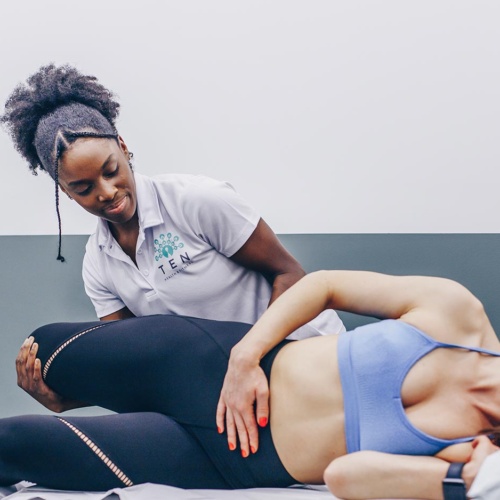
Accommodation of special considerations: not only can Pilates be performed on a one-one basis including specific exercises to ensure the benefits outline above, it can be performed in various positions. This is important when considering pain and loss of movement. Pilates exercises can be modified to be performed standing/sitting/supine lying/side-lying/on all fours.
 

Advice on exercising Post Breast Cancer

Strengthening before procedure: prehabilitation is a word more commonly used today, meaning beginning a strengthening programme prior to a procedure to ensure return to full function as soon as possible afterwards. Strengthening of the upper back muscles and in particular, the rotator cuff, beforehand would improve posture afterwards and restore shoulder joint function quicker.

Exercise in a cool environment and away from direct sunlight: exercising in a hot environment puts an increased demand on the circulatory system to dissipate heat. The compromised lymphatic system may struggle to cope with this sudden surge in circulatory demand and lymphodema may result.

Wear loose fitting comfortable clothes whilst exercising: with consideration of scarring and pain it is important to be comfortable when exercising. If any movement is causing increased pain and discomfort, change the position and/or regress to an easier exercise, stopping if this doesn’t help. Loose fitting clothes prevents overheating which, as stated, poses a risk for lymphodema.

Monitor the intensity: it is preferable to exercise in a supervised environment, not only to ensure the right exercises are being performed, but for the intensity to be monitored. Apart from the risk of lymphodema development, overall physical fatigue can be high following operative procedures especially when there is significant emotional trauma.

It is important that the exercise sessions do not leave you feeling exhausted and out of action for the rest of the day. To prevent the occurrence of the "one step forward, two steps back" cycle, increase the intensity slowly.
 

For more information, please visit Breast Cancer Care.


Back


FAQ | Privacy Policy | Waiver Policy | ©TenPilates 2007 | TenPilates is the trading name of Ten Health & Fitness Ltd